
Sustainability report design: beyond hard data & compelling stories
For corporate reporting leaders, the annual sustainability report is the ultimate balancing act: you are juggling rigorous ESG data and the need to...
3 min read
Agnes Sundblad : January 16, 2026
For corporate reporting leaders, the annual sustainability report is the ultimate balancing act: you are juggling rigorous ESG data and the need to craft a compelling narrative that resonates with stakeholders. Moreover, with the shift from the Non-Financial Reporting Directive (NFRD) to the Corporate Sustainability Reporting Directive (CSRD), the importance of sustainability report design will continue to increase in the upcoming years.
However, there is a pillar that holds this structure together, which is often undervalued: sustainability report design. Great design is not merely about making the report look attractive; it is about accessibility, navigation, and reinforcing your brand’s commitment to transparency.
Yet, for many organisations, the design phase is where the process unravels. Design bottlenecks and version control nightmares often threaten to derail the project timeline. Here is how forward-thinking teams are moving beyond silos to keep content creation, compliance, and layout in perfect sync.
Traditionally, the reporting workflow is linear and fragmented. Content teams draft text in Word and data teams crunch numbers in Excel. Only once these drafts are "finalised" are they handed over to the design agency to be laid out in Adobe InDesign.
The problem? In the world of corporate reporting, nothing is ever truly "final" until the moment of publication. As stakeholders review the designed proofs, they inevitably spot errors or require tonal shifts. These changes are sent back to the designers – often via email or marked-up PDFs – who must then manually implement edits.
This disconnect turns the final weeks of reporting into a high-stress race against the clock. A paragraph grows by three lines, breaking the page layout, or a graph is updated, causing data discrepancies. This "bolt-on" approach to design, where data is pasted in at the end, becomes increasingly risky as the volume of required data points scales into the thousands.
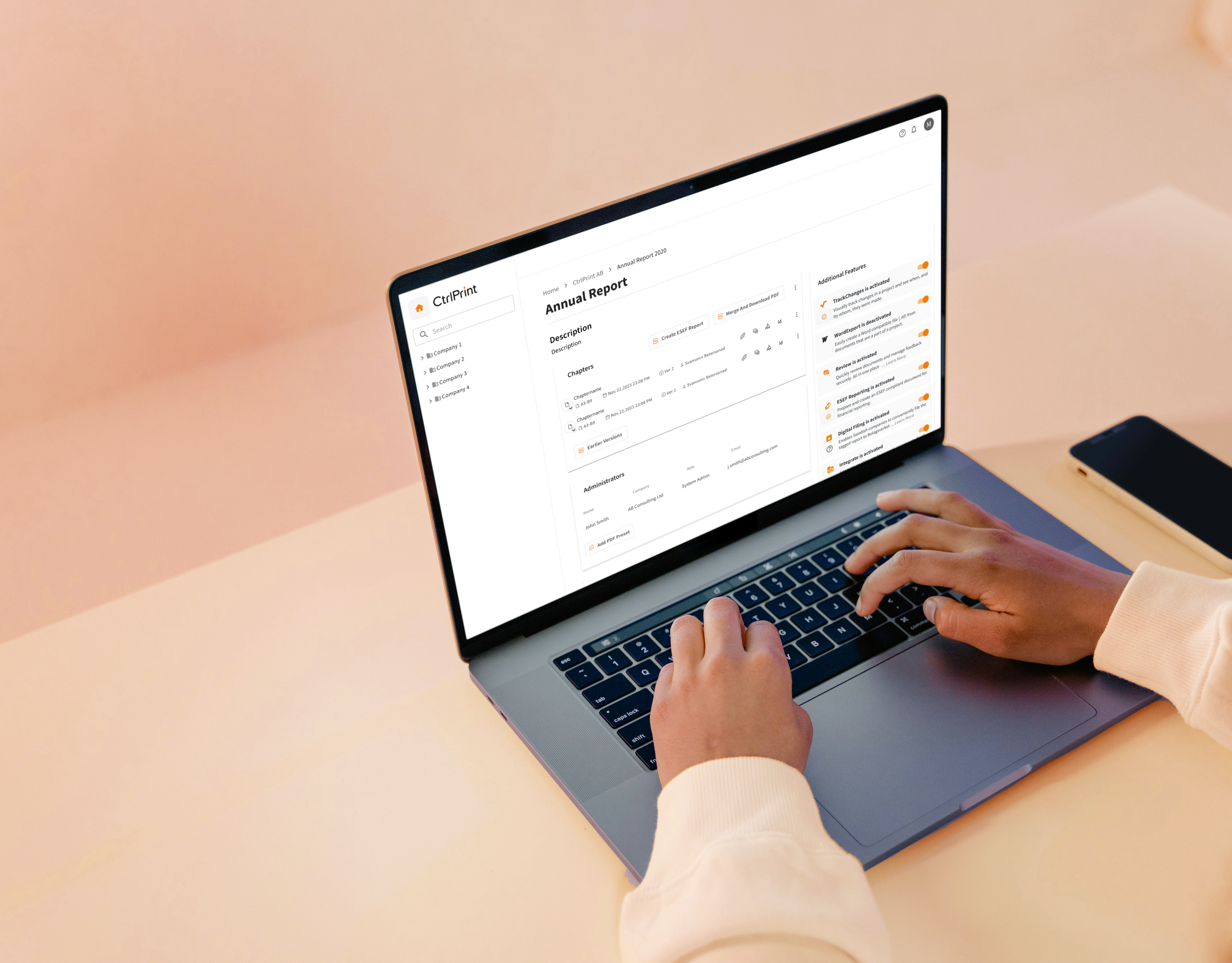
To maintain design integrity from the first draft to the final publication, the wall between "content" and "design" must come down. This is where a collaborative platform like CtrlPrint transforms the landscape.
By allowing content teams to work directly within the layout – without needing to know how to use complex design software – you eliminate the translation layer that causes so many errors.
The most effective workflow is one where content and design happen in parallel rather than sequentially. With the right platform, content teams can start working directly in their familiar environments – InDesign, Word, and Excel – but with a crucial difference: they are connected through a central cloud solution.
This means that while the agency focuses on the high-level sustainability report design concepts and visual hierarchy, copywriters can input text directly into the live layout. There is no need to wait for a "final" Word document. You can see immediately if your narrative fits the allotted space or if it needs trimming to preserve the visual impact.
Modern sustainability reporting is not just about aesthetics; it is about technical compliance and data fidelity. However, understanding when and how to apply digital layers to your report is critical to avoiding unnecessary stress.
The introduction of CSRD requires companies to report on over 1,000 potential data points. While the long-term goal of the directive is to have all this data digitally tagged (using XBRL), the immediate focus for many organisations in the 2024 and 2025 reporting cycles should be on data gathering and accuracy.
Legislative delays regarding the specific tagging rules (the XBRL taxonomy) mean that for many, the mandatory "tagging" of sustainability data may not be enforced until later cycles. However, waiting until the last minute is not a strategy. Adopting an integrated platform now allows you to structure your data correctly, ensuring that when the mandatory tagging timeline arrives, you are ready to apply tags directly to your reporting documents without overhauling your workflow.
Similarly, for UK-listed companies, the UK Single Electronic Format (UKSEF) is becoming a central topic. While financial tagging is mandatory, the tagging of sustainability data – specifically Streamlined Energy and Carbon Reporting (SECR) – currently remains voluntary.
However, many forward-thinking companies are choosing to tag this data voluntarily to enhance transparency and future-proof their reports. Using a platform that supports these taxonomies allows you to seamlessly add these digital layers if you choose, without being forced into a rigid compliance corner before it is legally required.
Ultimately, the goal is to produce a report that is both compliant and visually stunning. Because the report is built and managed within professional tools like Adobe InDesign throughout the entire process, the final result retains full design and brand fidelity.
Whether you are outputting an interactive online report, an iXBRL package, or a print-ready PDF, the design remains consistent. There is no "data version" that looks different from the "brand version". It is one cohesive document that connects clients, auditors, agencies, and regulators into one seamless environment.
The days of treating design as a post-production wrapper are inefficient. By integrating the drafting, reviewing, and design phases, you not only save time but also ensure that your sustainability story is told exactly as you intended – without the risk of last-minute layout breaks or data version discrepancies.
When content and design work in harmony, your report becomes more than just an obligation; it becomes a powerful asset for your brand.
Request a demo of CtrlPrint here.
For corporate reporting leaders, the annual sustainability report is the ultimate balancing act: you are juggling rigorous ESG data and the need to...
The short answer: Ideally, your sustainability report should be published simultaneously with your Annual Report. For most companies with a December...
For years, Diversity, Equity, and Inclusion (DEI) initiatives were the loud, proud centrepiece of the Annual Report. CEOs competed to showcase the...
The short answer: Ideally, your sustainability report should be published simultaneously with your Annual Report. For most companies with a December...
For North American reporting leaders, the regulatory landscape has traditionally been defined by a clear focus: financial materiality. This standard...
For years, Diversity, Equity, and Inclusion (DEI) initiatives were the loud, proud centrepiece of the Annual Report. CEOs competed to showcase the...