4 min read

The German financial landscape in 2026: balancing HGB tradition with IFRS & CSRD evolution

The German financial landscape in 2026: balancing HGB tradition with IFRS & CSRD evolution

For companies operating in Germany, Austria and Switzerland, the financial reporting year of 2026 represents a crossroads between the country’s historic, creditor-focused accounting tradition and the modern, data-driven transparency requirements of the European Union. Whether you are a local GmbH or a multinational group, navigating the German way of reporting requires understanding three distinct pillars: HGB, IFRS, and the newly mandatory CSRD.

1. The core pillar: German HGB (Handelsgesetzbuch)

The Handelsgesetzbuch (German Commercial Code) remains the bedrock of German accounting. Unlike English-American standards that prioritize fair value for investors, HGB is deeply rooted in the Prudence Principle (Vorsichtsprinzip) which lists the following:

  •  The primary goal of HGB is to protect creditors by preventing companies from overstating their assets or distributing unearned profits.
  • Under HGB, assets are generally recorded at historical cost. If their value drops, they must be written down; however, if their value increases, they usually cannot be written up above the original cost.
  • Even if a company prepares consolidated reports under IFRS, its individual German legal entities must still prepare a separate HGB balance sheet for tax purposes and dividend distribution.

Recent updates to the HGB ( facilitated by the Growth Opportunities Act ) have further digitized the submission process. Furthermore, for the 2026 reporting cycle, HGB increasingly incorporates specific valuation rules for green assets, such as national emission certificates under the Fuel Emission Trading Act (BEHG). 

2. Supporting the "Mittelstand": The VSME framework

For the millions of non-listed German SMEs that fall below the CSRD thresholds, 2024 introduced the VSME (Voluntary Sustainability Reporting Standard for SMEs). This framework is designed to protect smaller firms from the trickle-down administrative burden.

A critical 2026 legal development in this framework is the "Cap" function. Large German corporations (like Siemens or BMW) are now legally discouraged from demanding more ESG data from their SME suppliers than what is defined in the VSME. This prevents the long process that previously plagued the German supply chain. The VSME is structured to be scalable for different sizes of Mittelstand companies:

  • Basic Module: A simple entry-level report with minimal metrics for micro-enterprises.
  • Business Partner Module: Specifically designed to provide the data that German banks (Sparkassen/Volksbanken) require for Green Loans and that B2B customers require for procurement.

3. The role of GRI: From pioneer to strategic bridge

The GRI (Global Reporting Initiative) remains highly influential in Germany for the 2026 reporting cycle. Rather than being replaced, GRI acts as a technical foundation for two reasons:

  • Interoperability: EFRAG and GRI have achieved high alignment. For German multinationals, reporting under GRI often covers up to 90% of the data required for ESRS. Using GRI allows German global players to maintain a single reporting language for both EU regulators and international investors in the US or Asia.
  • The Blueprint for Impact: Many German auditors (Wirtschaftsprüfer) still recommend the GRI Sector Standards as best-practice guides for companies to identify their specific environmental and social impacts before mapping them to the legal ESRS requirements.

GRI is arguably more important in Switzerland than in Germany. Many Swiss global players like Nestlé or Novartis have used GRI for decades. In 2026, the Swiss government allows companies to use international standards like GRI or ESRS to fulfill their local legal duties.

4. IFRS 18 and beyond

For capital market-oriented companies, IFRS Accounting Standards are mandatory for consolidated financial statements. While the official effective date for IFRS 18 is January 1, 2027, the 2026 financial year is the critical comparative period. Moreover, German companies must already structure their 2026 data to match the new IFRS 18 requirements to ensure year-over-year consistency.

FRS 18 replaces IAS 1 and introduces three new categories (operating, investing, and financing) and two mandatory subtotals: operating profit and profit before financing and income tax. Companies must now disclose and reconcile non-GAAP measures like "Adjusted EBITDA" within a single note in the audited financial statements, increasing the governance over alternative success metrics. Many large German groups maintain a dual system reporting in IFRS for their global investors while maintaining HGB records for local tax compliance and statutory profit distribution.

5. CSRD

The most significant change for 2026 is the full-scale implementation of the Corporate Sustainability Reporting Directive (CSRD). While the largest public-interest entities began reporting in 2025, 2026 is the critical transition year for Wave 2 companies. These are large, non-capital-market-oriented companies that exceed at least two of the following revised thresholds (adjusted for inflation in late 2024/2025):

    • Balance sheet total: ≥ €25 million
    • Net turnover: ≥ €50 million
    • Employees: ≥ 250

    Under the CSRD, these companies must now include a sustainability report in their management report (Lagebericht), tagged digitally in iXBRL format and audited by a third party with limited assurance. Companies must report not just on how climate change affects their business (outside-in), but also on how their business affects the environment and society (inside-out). Switzerland has its own "Swiss Code of Obligations" (Art. 964a et seq. CO). While it mirrors the CSRD's spirit, it focuses heavily on Double Materiality and Climate Disclosures (TCFD-aligned).

6. Filing and compliance deadlines

Corporations in Germany must publish their annual reports in both the Commercial Register (Handelsregister) and the Federal Gazette ( Bundesanzeiger ). Since the DiRUG implementation on 1 August 2022, the Commercial Register has become the central platform for legally binding disclosures. While the legal deadline is December 31, the Federal Office of Justice (BfJ) usually grants a grace period (Schonfrist) before issuing fines.

Micro - entities (Kleinstkapitalgesellschaften) have a special privilege. They can choose to deposit (hinterlegen) their balance sheet instead of publishing it. This means the data is not publicly searchable by everyone on the web, but can be requested for a fee (e.g., by credit agencies).

2026 is the year many transition to IFRS 18 comparative data and CSRD reporting, the large and listed companies must ensure their digital filing uses the ESEF (European Single Electronic Format). This means your management report and sustainability report must be tagged so that AI and data analysts can read them instantly.

7. Integration of risk and governance

The year 2026 also sees a tighter integration of the German Corporate Governance Code (DCGK) and the Supply Chain Due Diligence Act (LkSG). Management boards are now legally required to maintain an internal control system (ICS) and risk management system that explicitly accounts for sustainability-related risks. Failure to do so can lead to direct management liability under Section 91 of the German Stock Corporation Act (AktG).

Key takeaway for 2026

Success in the German market now requires more than just balancing the books. Finance teams must integrate financial data (HGB/IFRS) with non-financial data (ESRS). With the 2026 merger of German accounting and auditing oversight, the era of siloed reporting is officially over. Reporting is no longer a back-office compliance task; it is a strategic communication tool.


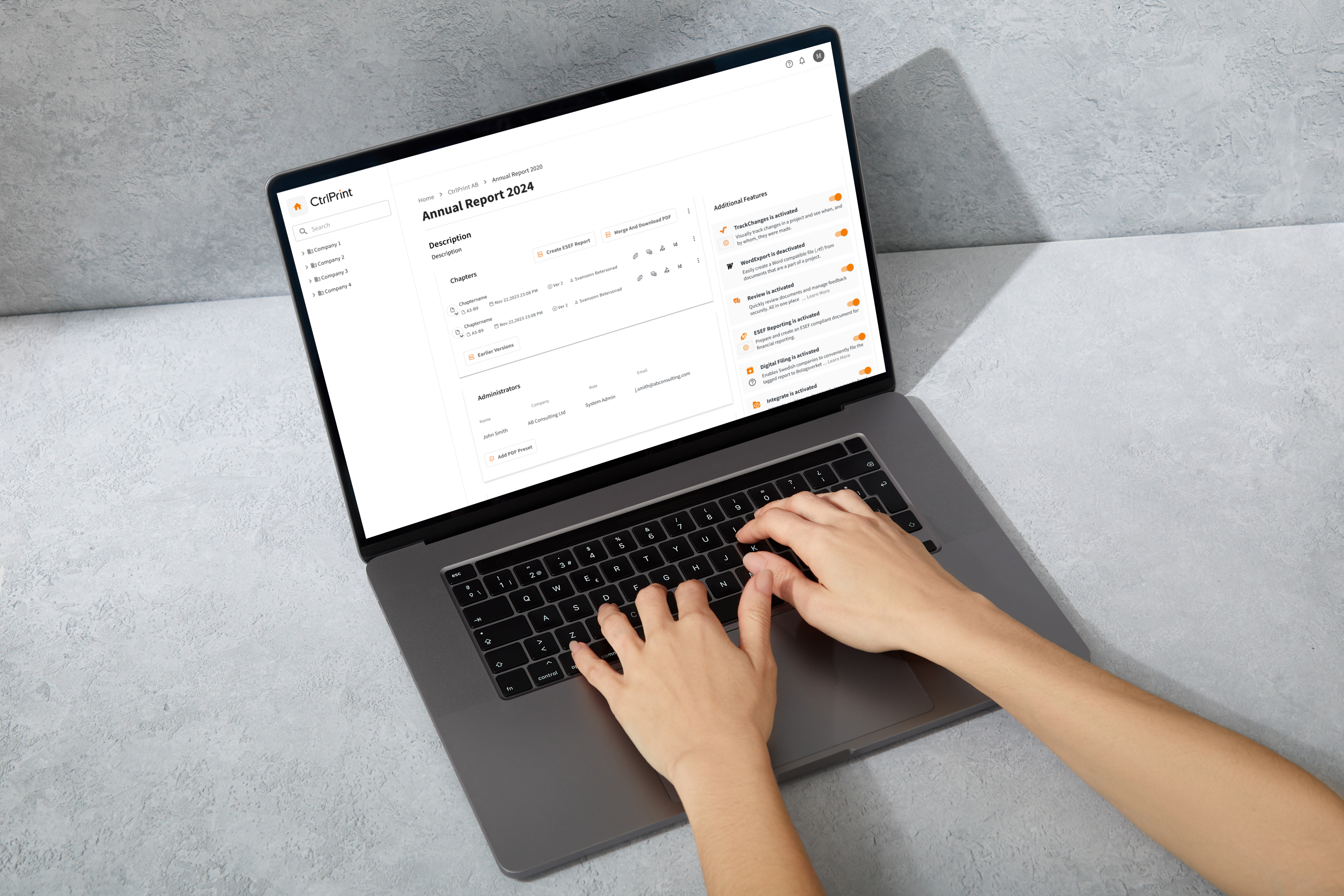
Request a demo today to see how CtrlPrint brings your reporting team together in one secure, high-performance environment.


Sources & Further Reading


The German financial landscape in 2026: balancing HGB tradition with IFRS & CSRD evolution

The German financial landscape in 2026: balancing HGB tradition with IFRS & CSRD evolution

For companies operating in Germany, Austria and Switzerland, the financial reporting year of 2026 represents a crossroads between the country’s...

Read More
Mastering global compliance: A strategic guide to IFRS

Mastering global compliance: A strategic guide to IFRS

The global standard: What is IFRS? The International Financial Reporting Standards (IFRS), governed by the IFRS Foundation, provide a "common...

Read More
Compliance reporting or enterprise value reporting?

Compliance reporting or enterprise value reporting?

Part III — Reporting in the age of digital comparability In this series of articles, our Head of Business Development, Per Närstad speak about...

Read More